Project Overview:
The DIN-Rail Meter: An Unsung Enabler of Africa’s & Southeast Asia’s EV Charging Ecosystem
Across Africa, the electric vehicle (EV) transition is gathering momentum, particularly in the commercial fleet and two-wheeler segments that dominate the continent’s transportation landscape. In South Africa alone, EV sales have seen consistent year-on-year growth, while countries like Kenya, Rwanda, and Nigeria are seeing rapid adoption of electric two-wheelers and three-wheelers for last-mile delivery and ride-hailing services.
At the heart of this infrastructure build-out lies a critical but often overlooked component: the DIN-rail mounted energy meter. These compact devices, designed to snap onto standard 35mm DIN rails inside electrical cabinets, have become indispensable for charging station operators facing two fundamental challenges—space constraints and the need for accurate, reliable energy measurement in distributed deployment environments .
For charging station operators in Africa, the DIN-rail meter offers unique advantages:
Space optimization. In dense urban environments where charging stations must be installed in existing parking facilities, retail centers, and commercial buildings, cabinet space is at a premium. DIN-rail meters occupy up to 80% less space than traditional wall-mounted meters, enabling operators to deploy multiple charging points within a single compact enclosure .
Bidirectional metering and time-of-use billing. As African electricity grids transition toward more sophisticated tariff structures, DIN-rail meters with bidirectional energy measurement capabilities enable operators to implement time-of-use (TOU) billing—critical for managing peak load pressures and optimizing charging station economics. Meters supporting bi-directional energy registration can also facilitate vehicle-to-grid (V2G) applications as the technology matures .
Multi-communication support for remote management. In a continent where central monitoring and remote management are essential for operational efficiency, DIN-rail meters supporting RS485, NB-IoT, and Modbus-RTU protocols enable seamless integration with cloud-based charging management platforms—allowing operators to monitor energy consumption, manage billing, and perform remote diagnostics across geographically dispersed charging networks .
Local regulatory compliance. Leading DIN-rail meters meet IEC 62052/62053 international standards and MID certification requirements, providing the assurance that charging station operators require for accurate billing and regulatory reporting. Some manufacturers also offer custom certification support for specific African market requirements .
Daweda’s DIN-rail meter solutions are designed to meet these demands, delivering the accuracy, reliability, and communication flexibility that African charging infrastructure projects require—from urban fast-charging hubs to off-grid solar-powered charging stations in remote areas.
Southeast Asia’s Electric Two-Wheeler Revolution: The Role of Smart Metering
Southeast Asia is witnessing one of the world’s most dynamic electric mobility transitions, driven by the region’s massive two-wheeler market. Countries including Indonesia, Thailand, Vietnam, and the Philippines are experiencing exponential growth in electric motorcycle and scooter adoption—with Indonesia alone targeting 2.5 million electric two-wheelers on its roads by 2027.
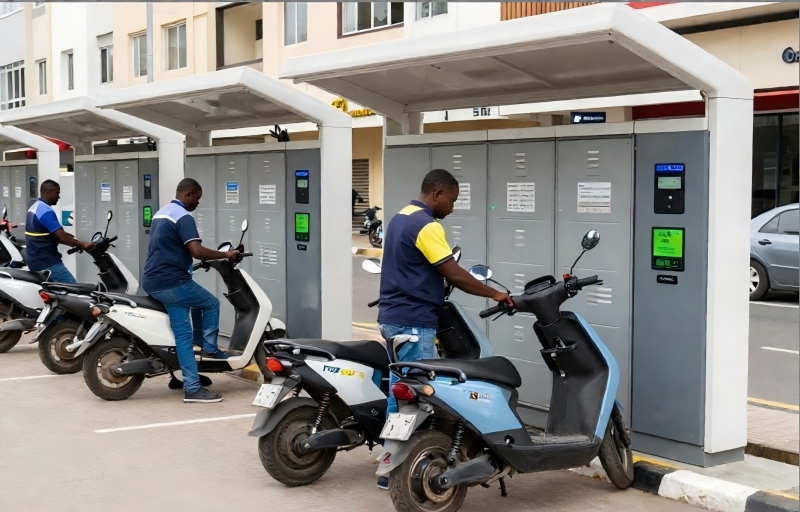
This surge in electric two-wheelers is, in turn, driving rapid expansion of battery-swapping infrastructure. In cities like Jakarta, Bangkok, and Ho Chi Minh City, battery-swapping stations are proliferating, offering riders the ability to exchange depleted batteries for charged ones in seconds rather than waiting for charging cycles to complete.
DIN-rail meters play a pivotal role in this ecosystem by enabling accurate energy measurement at each battery-swapping cabinet. This ensures:
-
Precise energy accounting. Operators need to track energy consumption per swap to manage electricity costs and optimize charging schedules. DIN-rail meters provide the granular consumption data required for operational decision-making .
-
Remote monitoring and maintenance. With hundreds or thousands of swapping cabinets spread across urban areas, remote visibility into each cabinet’s energy consumption and operational status is essential. Meters with RS485 communication and Modbus-RTU protocol support enable centralized monitoring platforms to collect real-time data .
-
Tariff optimization. As Southeast Asian countries implement more sophisticated electricity tariff structures—including time-of-use (TOU) rates—operators can schedule battery charging during off-peak periods to minimize costs, with DIN-rail meters providing the consumption data needed for accurate cost allocation .
The region’s charging infrastructure also includes conventional charging stations for electric cars and commercial fleets, where three-phase AC and DC fast-charging solutions require high-precision metering. For DC fast-charging applications, specialized DIN-rail DC meters with 0.5S accuracy class are increasingly specified to measure voltage up to 1000V, supporting both direct shunt and Hall sensor input configurations .
Multi-Scenario Applications: Beyond Two-Wheelers
Beyond EV charging and battery-swapping, DIN-rail meters are finding expanded applications across Africa and Southeast Asia’s energy landscape:
-
Building energy management. Commercial and industrial facilities deploy DIN-rail meters for sub-metering across floors, tenants, and equipment categories, supporting energy-saving initiatives and cost allocation .
-
Photovoltaic system monitoring. Solar PV installations, which are proliferating across both regions to address energy access challenges and sustainability goals, rely on DC DIN-rail meters for monitoring generation output and system performance .
-
Prepaid energy solutions. In markets where prepayment is prevalent—particularly in parts of Africa—DIN-rail prepayment meters enable pay-before-you-use models that reduce revenue leakage and improve cash flow for utilities and infrastructure operators .
Daweda’s comprehensive metering portfolio—encompassing AC and DC DIN-rail meters like DDE-M1D03,DDE-M1D05, DDE-M3D01, DDE-M3D02 ;data concentrator units (DCUs), MDMS, and cloud-based IoT platforms—positions the company to support the full spectrum of energy measurement and management requirements across these diverse application scenarios.
Customer Photos: